Overhead, Underrated: What London Ceilings Do to a Room After Dark
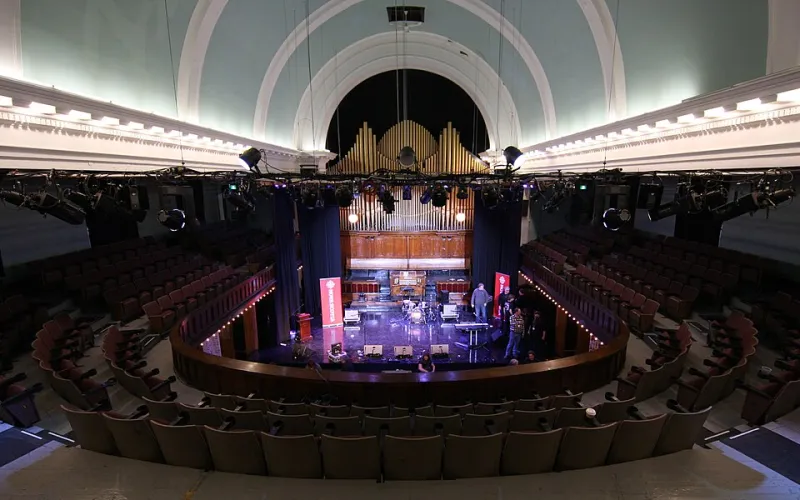
Photo: Ken Heaton, CC BY-SA 4.0, via Wikimedia Commons
When you walk into a venue, you look at the bar, the floor, the crowd, the light. You almost never look up. Which is odd, because the ceiling is doing more work than almost anything else in the room. It is the fifth wall, the overhead plane, the surface that decides whether sound stays tight or smears, whether lighting feels deliberate or desperate, whether a full room feels intimate or airless.
In London, where so many venues are conversions — warehouses, railway arches, hotels, basements, former factories — the ceiling is often the most honest part of the building. It tells you what the room was before it became a room you could hire. And it tells you what the room can become after dark.
The Ceiling Is an Instrument
Acousticians talk about absorption, diffusion and reflection. In practice, that means the ceiling is either helping sound behave or letting it run wild. A low, soft ceiling absorbs energy; a high, hard ceiling reflects it. A blacked-out box can swallow sound and light, making a room feel focused and clubby. An exposed industrial ceiling can look magnificent and sound chaotic, with every duct and beam sending reflections in unpredictable directions.
“The ceiling is where the room decides whether it wants to be a conversation or a concert,” one London acoustician told me. “You can fight it with speakers and treatment, but you are always fighting it. The best rooms work with the overhead plane from the start.”
That is why acoustic clouds — those suspended panels you see over dining rooms and listening bars — are not just visual filler. They break up reflections, reduce flutter and let a room hold a crowd without forcing everyone to lean in and shout.
What Lighting Designers See Up There
Lighting designers look at the ceiling differently again. For them, it is a grid, a power source and a blackout opportunity. A good ceiling gives you positions for spots, washes, pendants and practicals without turning the room into a tangle of cable. A bad ceiling gives you glare, dead zones and the familiar sight of a lighting designer improvising with gaffer tape twenty minutes before doors.
“A ceiling can make a room feel twice as tall or half as generous,” one lighting designer who works across London’s mid-size venues said. “Paint it black and you hide the services, but you also change the emotional temperature. Add a grid and suddenly the room can become three different rooms across one night. That flexibility is worth more than a feature pendant.”
The overhead plane also controls contrast. A dark ceiling makes low-level table lighting feel intimate. A bright ceiling flattens everything. In private-hire rooms, that matters: the same space has to work for a drinks reception, a dinner and a late set. The ceiling is the thing that lets it switch.
Four Rooms, Four Overheads
The Barbican Hall is the obvious place to start. Its adjustable acoustic canopy is a reminder that ceilings can be active infrastructure, not passive surface. The room is designed to change with the event, and the overhead plane is part of the performance.
A listening bar such as Spiritland takes the opposite approach: low, warm, domestic, with the ceiling pulled down to make the room feel like a living room that happens to have a serious sound system. The overhead plane is close enough to matter, soft enough to tame reflections, and low enough to make the whole experience feel enclosed.
Corsica Studios is the black box model. Low ceilings, exposed services, dark surfaces, sound doing the heavy lifting. It is not pretty in the conventional sense, but the overhead plane is doing exactly what a club ceiling should do: keeping energy in, keeping distractions out, letting the room feel like a single organism.
The Ned is the grand-room counterpoint. High, ornate, historic, beautiful. But height and hard surfaces can let sound wander, which is why the best events there are the ones that either lean into the scale or bring their own acoustic discipline. A stunning ceiling is not automatically a useful one.
What This Means When You Hire a Room
For anyone booking a private-hire space, the ceiling should be on the site-visit checklist alongside capacity and minimum spend. Ask how high it is. Ask what it is made of. Ask whether there is acoustic treatment and where it sits. Ask where the lighting positions are and whether you can rig your own. Ask about blackout. Ask what the air handling sounds like when the room is full.
A beautiful ceiling can be a liability for a band. A plain ceiling can be a blank canvas. A low ceiling can create atmosphere and claustrophobia in equal measure. The point is not to prefer one style; it is to know what the overhead plane will do to your event before you sign.
The Overhead Audit
Look up on the visit. Take a photograph of the ceiling. Ask for the ceiling plan if one exists. Stand where the dancefloor will be and listen to the room empty; then imagine it full. Check whether the lighting grid can give you the mood you want without cable spaghetti. Confirm whether the ceiling is treated or naked. And ask what happens to sound when the room reaches capacity.
The best London rooms are not always the ones with the most dramatic ceilings. They are the ones where the ceiling has been considered — where someone has asked what the overhead plane should do, and then made it do that. The fifth wall is not decoration. It is the quiet infrastructure of a good night out.