The Fifth Chair Problem: Where London Actually Wants Your Party of Five

Photo: five friends toasting around a round corner banquette table in a warm London restaurant, via images.theconversation.com
Four is a table. Six is a party. Five is a negotiation — with the booking system, with the room, and occasionally with the friend who ends up on a stool in the walkway that was never designed for a human being over the age of twelve.
That's the odd-number problem in a nutshell. London's dining rooms, bars and cultural venues are built on even numbers: twos by the window, fours in the middle, sixes along the back wall. A party of five doesn't slot into that grid. It has to be engineered.
Why five changes the night
There's a social reason and a physical one, and they compound.
The social: an even group can pair off, and usually does. Five can't. The conversation has to hold as one, which makes for a faster, funnier, more exposing table — nobody at a five has a private side-chat to retreat into. There's a pivot person in the middle, and everyone knows who it is by the second drink.
The physical: a five is generally a four-top with a chair pulled into the traffic, or a six-top with a ghost. The first puts one guest in the aisle. The second puts a gap in the round, and the gap becomes the loudest thing at the table. Either way, the room has told you something: it didn't plan for you.
The rooms worth booking are the ones that did.
What an actual five-top looks like
It's less a table size than a shape. Three configurations work:
- The run. A counter or bar-height ledge with five stools. Everyone faces the same way, which sounds antisocial and isn't — elbows, plates and one shared sightline do more for a five than a wonky square ever will.
- The corner. A banquette down one wall with three chairs opposite. The corner absorbs the odd number, and whoever lands in it gets the best seat rather than the punishment one.
- The round, or near-round. Rare, precious, and worth asking for by name.
What doesn't work: the long refectory bench, where five splits into a three and a two and the two have a distinctly better night than the three. Also the "we'll push two tables together" — which puts a seam down the middle of the evening and a wobble under somebody's glass.
Where five is a feature rather than a squeeze
Counters and chef's tables. The odd number's best friend. A five-seat run at a prep counter or pass is a proper booking in its own right, not a compromise. Ask directly: "do you take five at the counter?" The answer tells you a lot about the room.
Alcove dining rooms. Small rooms in Clerkenwell, Marylebone and Bermondsey that top out at 24–34 covers often have a corner that seats five comfortably, because the layout was drawn by someone who once tried to seat five badly and learned from it.
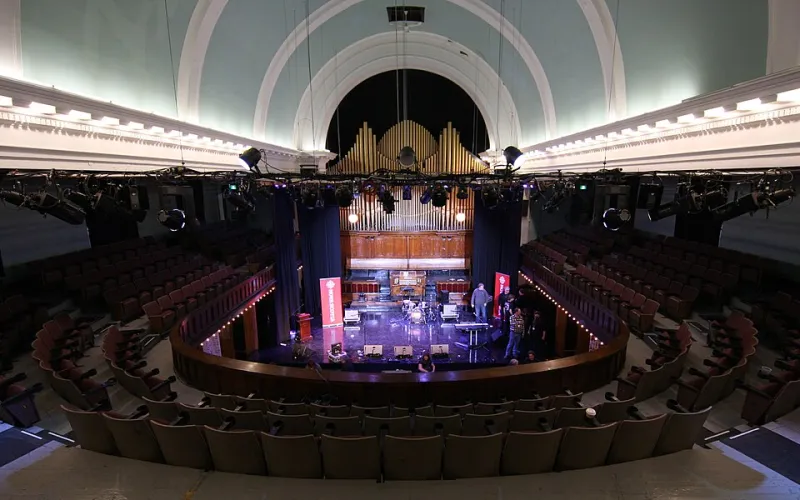
Cultural venues. Studio theatres with unreserved rows, small concert halls with odd-numbered boxes, and gallery lates all handle five better than most restaurants. Nobody at a jazz club is counting chairs.
Hotel dining rooms, off-peak. Hotel restaurants are built to absorb irregular parties, and their 6pm is often a softer booking than a neighbourhood room's 7.45.
The private-room trap
This is where organisers get caught. You ask for five, the room is full, and someone offers you "the Library" or "the Snug" — with a minimum spend that assumes you're a corporate awayday.
Sometimes that's the right call. A private room earns its minimum when the group genuinely wants to be loud, when there's a speech, or when the night itself is the point rather than the meal. For a standard five, it's usually a bad trade: you've swapped a live room for a quiet one, you've added a spend target to an evening that had no structure, and you've turned the organiser into the accountant.
The polite refusal, if you need one: "Thanks — we'd rather be in the room. Can you do us a five at 6.30 or 9.15 instead?"
The organiser's checklist
Five points, and you'll hear the difference in the room:
- Ask what table you're getting, not just whether there's space. "Is that a five-top, or a four with a chair?" is a completely reasonable question and tends to produce a straight answer.
- Book the shoulder, not the peak. 6.15–6.45 and 9.15–9.45 are when a room has slack to be generous. A 7.45 five is a five the kitchen quietly resents.
- Confirm the fifth seat is a chair. Stools are fine at a counter and less fine when someone's eating pasta at chest height.
- Midweek over Friday. Tuesday and Wednesday rooms can flex. Friday has no slack, and slack is precisely what an odd number needs.
- Reconfirm 48 hours out. One no-show from five is a 20% hole in a table, so venues hold fives loosely until they're sure.
The point of it
A five should feel deliberate. When it lands, you get the table that stays put after the plates are cleared, where nobody is craning round a pillar and the conversation doesn't quietly fracture into couples. That isn't luck, and it isn't a bigger budget — it's one extra question at the booking stage.
Ring ahead. Ask for the corner. Take the counter. The odd number is the point, not the problem.