The Forecast Is an Invitation: London Rooms Built for a Proper Downpour

Photo by Photo by Trevor Minett on Unsplash on Unsplash
London in the rain is not a city to be endured. It is a city with a different floor plan. The usual routes thin out, the pavements turn reflective, and the venues that understand weather start to feel like the only sensible places to be. This winter 2026, the best nights are not the ones that ignore the forecast. They are the ones that read it, adapt, and make the downpour part of the atmosphere.
A good wet-weather venue is not simply indoors. It has a threshold that works, a ceiling that holds the noise in, windows that steam rather than stream, and a doorway worth lingering in while you shake out the umbrella. It gives you a reason to arrive early and a reason not to rush the last drink. Here is where London gets that right.
The doorway is the first room
Watch how a venue handles the thirty seconds between street and bar. The best ones give you a covered pause: an awning, a recessed entrance, a lobby that isn’t just a security desk. The Barbican’s raised walkways and lakeside foyer are a masterclass in this. You arrive damp, but you are not exposed. The building gathers you in, and the night begins before you have found a seat.
The same is true of the Southbank Centre’s Royal Festival Hall. On a wet evening, its foyers become a kind of indoor promenade, full of people who have swapped a walk along the river for a slow circuit of the bar. The rain is still there, visible through the glass, but it has been demoted to scenery. That is the trick: not pretending the weather isn’t happening, but giving it a supporting role.
Go under glass
Covered markets and arcades are London’s original wet-weather infrastructure. Leadenhall Market, with its Victorian roof and warm pub lights, becomes more atmospheric when the City is slick and empty. The rain drums above, the cobbles below stay dry enough, and the whole place feels like a stage set that has been left on for you.
Hay’s Galleria, down by London Bridge, has a similar effect: a glass roof, a long central run, and enough surrounding bars and restaurants to make it a natural wet-weather base. Coal Drops Yard at King’s Cross is another useful one. The canopy and the surrounding buildings mean you can move between spots without a full soaking, and the industrial scale makes the rain feel like part of the lighting rig.
These are not secret places. The trick is timing. Arrive before the post-work surge, take the table you can see from, and treat the covered route as the evening’s first act rather than a corridor to somewhere else.
Basements reward the committed
There is a particular pleasure in going underground when the sky is doing its worst. Basements mute the city. The rain becomes a distant tap, the street noise falls away, and the room takes on the feeling of a bunker that happens to serve very good Martinis. Brasserie Zédel in Piccadilly is the grand version: all mirrors, brass and low light, with the sense that you have left the weather several floors above. Smaller listening bars and cellar rooms do the same job with less theatre. You descend, you defrost, you stay for one more than you planned.
The practical appeal is obvious. No umbrella wrestling at the table, no draught every time the door opens, no negotiating a wet coat with a narrow banquette. But the atmospheric appeal is stronger. A basement makes a wet night feel deliberate. You didn’t end up there because it was raining; you chose it because it was raining.
The steamed-window table
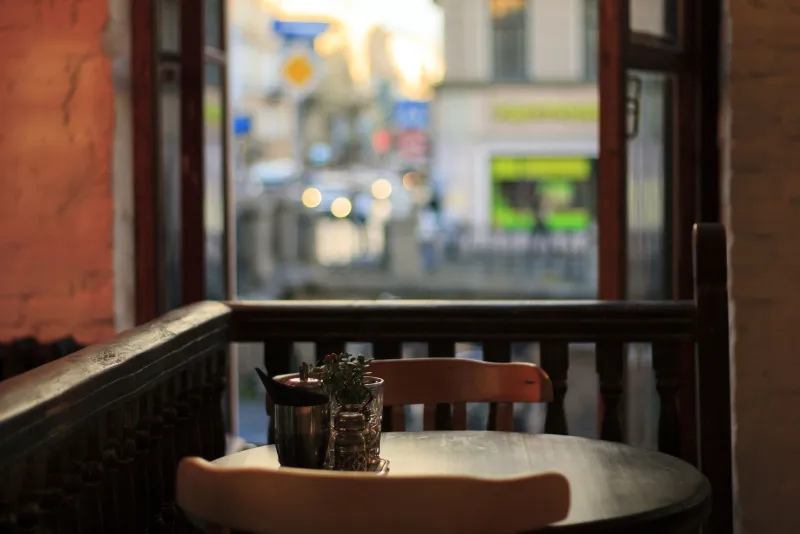
Then there is the simplest wet-weather venue of all: the room with a window that fogs up. A neighbourhood restaurant, a wine bar with too few tables, a pub where the glass has gone opaque by 8pm. These places do not need architecture to do the work. The condensation does it for them. It creates a private world, a soft frame around the evening, and a perfectly legitimate reason to order another glass rather than face the walk to the Tube.
In winter 2026, with bookings still tight and no-shows still annoying, wet weather can also be an opportunity. Tables open up when the forecast turns. Call ahead, be flexible about the room, and ask for a spot away from the door. The best wet-weather nights are often the ones that were not planned around a specific venue but around a specific feeling: warm, dry, close, and not quite ready to leave.
A small wet-weather protocol
Dress for the walk, not the room. Book the second sitting rather than the first if you want the place to have settled. Check whether the cloakroom is a real one, not a pile of coats behind a chair. And give yourself one covered stop between the station and the main event: an arcade, a market, a hotel lobby with a long bench. Burlington Arcade and the Piccadilly Arcade are not destinations in themselves, but on a wet night they are excellent punctuation.
The rain will keep coming this winter. The city’s best rooms know that already. They have built the awning, dug the basement, lit the window and left the door open just enough. Your job is simply to read the forecast and choose the room that turns it into an invitation.